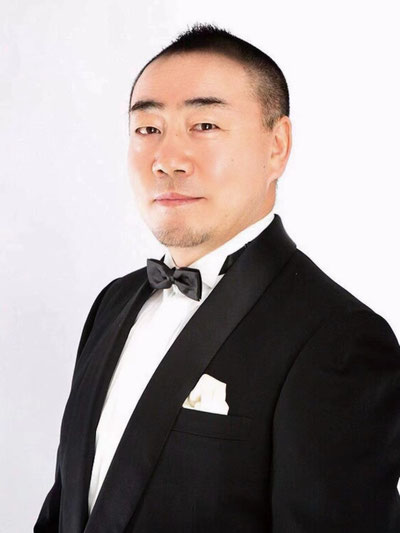
Jinzhong Bao | Tenor, Vocal Educator
Jinzhong Bao is a Mongolian Chinese tenor and vocal educator based in Japan. Originally from Tongliao, Inner Mongolia, he is now primarily active in Nagoya and the wider Aichi region. For more than two decades, he has remained a prominent presence on Chinese cultural stages in central Japan, in events promoting cultural exchange between China and Japan, and in the field of vocal education. He is regarded as one of the representative Chinese tenors working in central Japan.
Bao earned his bachelor’s degree in vocal music from the College of Arts at Inner Mongolia University, where he studied under the renowned Mongolian vocal educator Professor Narenqimuge. During his studies, he was deeply influenced by the musical culture of the Mongolian grasslands, developing a broad, sincere, and emotionally rich approach to musical expression. At the same time, he received systematic training in Italian bel canto, which laid a strong foundation for his later work in opera and art song. While still a student, he achieved distinguished results in professional vocal competitions both within and outside the university, demonstrating the quality of his tenor voice and considerable stage potential.
In 2001, Bao moved to Japan for advanced study, specializing in Western classical singing and opera under the guidance of the distinguished Japanese vocal educator Professor Jiro Futagami. In 2007, he completed a master’s degree in vocal music at the Graduate School of Aichi University of the Arts. During his systematic studies in Japan, he further explored Italian opera, German and Austrian Lieder, Japanese art songs, and cross-cultural vocal expression. Over time, he developed a distinctive artistic style that combines the emotional depth of Chinese ethnic music, the musical character of Mongolian culture, and the technique of Western bel canto.
In professional competitions, Bao received Second Prize in Vocal Music at the Yangtze River Cup International Music Competition in Japan in 2002. In 2006, he won the Gold Award in Vocal Music at the 8th Great Wall Cup International Music Competition, as well as the Special Award of the Consulate-General of the People’s Republic of China in Osaka. These honors demonstrated his strong professional ability and laid an important foundation for his long-term career within the Chinese musical community in Japan and on stages devoted to cultural exchange between China and Japan.
Bao is a lyric-dramatic tenor with a rich, bright, clear, and full-bodied voice. His upper register possesses excellent projection and stability, while his middle and lower registers are warm and resonant. His singing combines the power of a dramatic tenor with the subtle expressiveness of a lyric tenor. He is equally capable of performing Western operatic arias by composers such as Puccini, Verdi, and Massenet, as well as Chinese art songs, Mongolian grassland songs, classic Chinese revolutionary works, and Japanese art songs.
Bao’s repertoire on the opera and concert stages is broad and stylistically diverse. He is particularly known for tenor arias such as Nessun dorma, Che gelida manina, La donna è mobile, and Pourquoi me réveiller. He has also been warmly received for performances of Chinese and Japanese classics including Motherland, My Kind Mother, Ode to the Motherland, Auspicious Grassland, and Subaru. His singing possesses both a grand, expansive vocal presence and a refined sincerity of expression. He is especially distinguished in conveying the feelings of overseas Chinese toward their homeland, the poetic atmosphere of the Mongolian grasslands, and the emotional resonance shared between Chinese and Japanese cultures.
For more than twenty years, Bao has been firmly rooted in central Japan, actively contributing to cultural exchange between China and Japan and to cultural activities within overseas Chinese communities. He has been invited on numerous occasions to perform at major events, including celebrations commemorating anniversaries of the founding of the People’s Republic of China, events marking the normalization of diplomatic relations between China and Japan, the Nagoya Chinese New Year Festival, and commemorative programs for China–Japan calligraphy, painting, and seal-carving exhibitions. Through professional vocal performance, he has served the overseas Chinese community while also contributing to people-to-people friendship between China and Japan. His artistic work has received attention and recognition from the Consulate-General of China in Nagoya, overseas Chinese organizations, and local cultural circles in Japan.
Bao has also actively pursued cross-disciplinary collaborations. He has performed with artists from China and Japan playing instruments such as the pipa, erhu, and piano, and has appeared in concerts at Shenzhen Concert Hall, in Nagoya, and in other cities throughout central Japan. By combining elements of Chinese traditional music and Mongolian music with Western bel canto, he has explored a form of cross-cultural vocal expression with a distinctive overseas Chinese character. His performances are intended not only for Chinese audiences, but also for local Japanese listeners, giving his work significant value as a form of cultural communication.
In addition to his stage career, Bao has long been engaged in vocal education. He operates a vocal studio in Japan, teaching Chinese international students, children from overseas Chinese families, Japanese vocal enthusiasts, and adult learners. His instruction emphasizes the integrated development of healthy vocal production, breath control, diction, musical expression, and stage presence. By combining the principles of Italian bel canto with Chinese ethnic vocal music and the characteristics of Mongolian musical expression, he adapts his teaching to the individual needs of students of different ages and levels. Over the years, he has trained many students who are now active in Chinese-community concerts, choirs, and vocal study, making a positive contribution to arts education and vocal training within Chinese communities in central Japan.
As a Mongolian Chinese tenor based in Japan, Bao’s artistic career reflects professional excellence, ethnic cultural identity, and a commitment to intercultural exchange. He combines formal conservatory training and recognition in international competitions with many years of direct involvement in overseas Chinese cultural activities and grassroots cultural exchange. He is equally at home performing masterpieces of Western opera and expressing, with deep feeling, Chinese vocal works, Mongolian music, and the cultural attachment of overseas Chinese communities to their homeland.
As an important collaborating artist of the Tokyo International Vocal Society, Bao will draw on his extensive experience in tenor performance, ethnic musical expression, cultural exchange between China and Japan, and vocal education to support the Society’s arts festivals, vocal training programs, promotion of Chinese musical culture, and arts education activities for overseas Chinese communities. His participation will further enrich the artistic scope of TIVS and help promote Chinese vocal repertoire in Japan and throughout the wider international community.



Tokyo International Vocal Society(TIVS) All Rights Reserved.